Guide
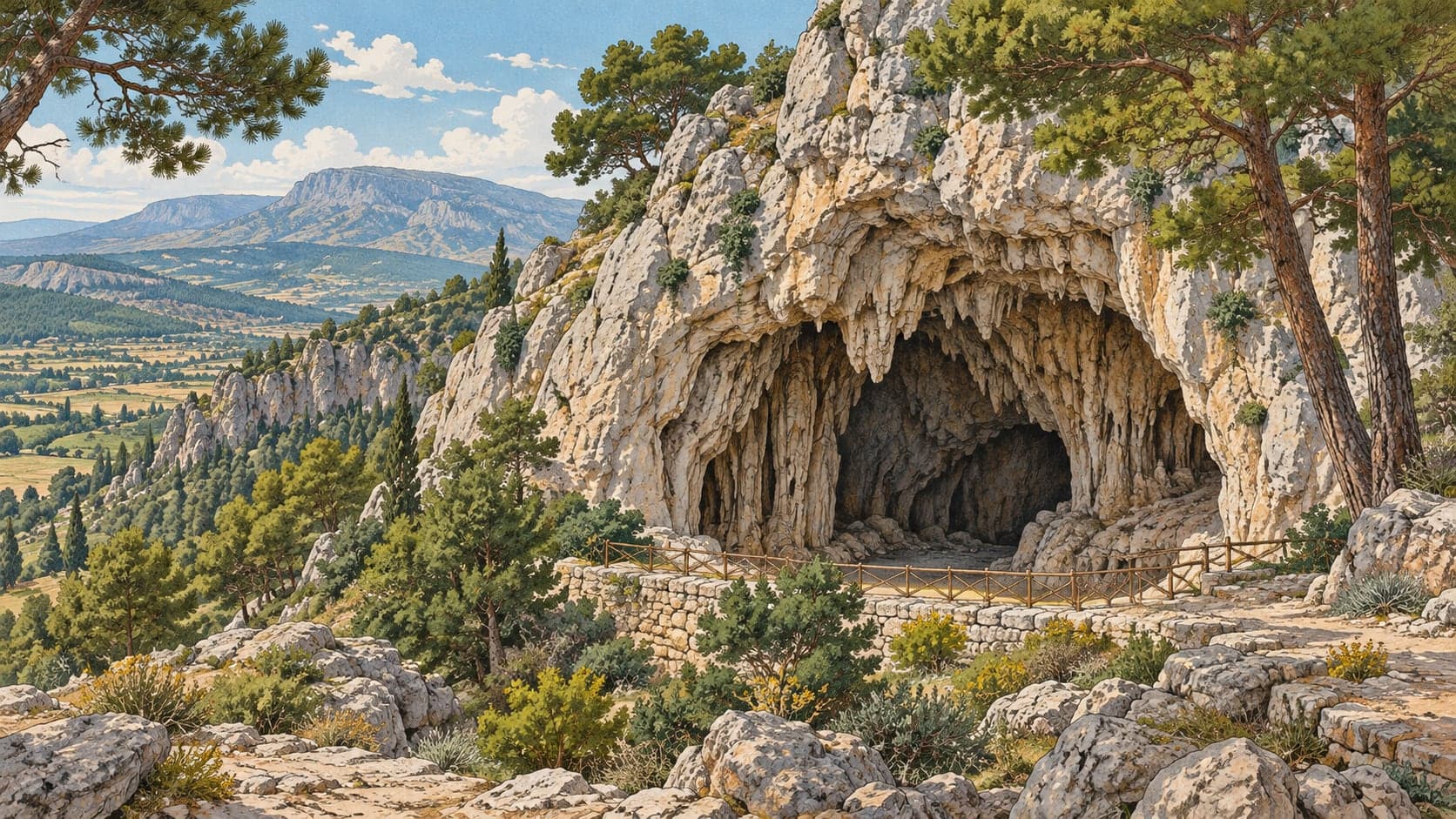
Keloğlan Cave lies within the bounds of the town of Dodurgalar in the Acıpayam district of Denizli, three kilometres from the Denizli–Antalya road. Its height runs about five to six metres and the visitor route is 145 metres long.
Until 1990 the cave drew no attention: only shepherds knew of it and it served no purpose. After applications by the Denizli governorship and the Dodurgalar municipality, the General Directorate of Mineral Research and Exploration carried out a study and it was decided to open the cave to visitors. It kept its natural appearance and was opened in 2003, one of thirty-one caves open to visitors in Türkiye.
The heavily fissured rock here lends itself to karst formation. The cave developed within Jurassic and Cretaceous limestones and is divided by dripstone columns into a great many interlinked chambers, which gives it an irregular, recessed shape. Dripstone formed along the fissures is abundant — stalactites, stalagmites, columns, and wall and sheet formations.
The cave is a single hall with a narrow entrance, broken into small chambers by the columns, and the air inside is damp and warm. In measurements taken in 1998 the temperature outside was thirty-two degrees and the absolute humidity sixty-five per cent.
Going in, one comes into a large gallery. Along it are stalactites of every kind formed over thousands of years, from the fine ones called soda straws to lace-like forms. Columns made where stalactites and stalagmites fed by dripping water have met, and travertine formations, give the cave much of its atmosphere; and where the large stalactites hanging from the wide cracks in the ceiling have joined stalagmites and one another, sections like rooms divided by natural walls have formed inside.
The walkways built under the project are lit, and the inside of the cave is watched by cameras. A small colony of bats lives at the entrance. The source says that cave settings of this kind, where stalactites and stalagmites have formed over long years from lime-bearing water dripping through karstic rock and soil, have been used in treating asthma and bronchitis, and the cave draws particular interest from people with asthma.