Guide
Aizanoi stands in the Çavdarhisar district of Kütahya, on the upper reaches of the Penkalas, today's Kocaçay. The city's own foundation story runs through Azan, a mythological figure named in ancient sources as a forerunner of the Phrygians and said to have been born of the water nymph Erato and the legendary king Arkas, who lived near the sacred cave of the goddess Meter Steunene. In age the city is a contemporary of Ephesus, Pergamon and Side.
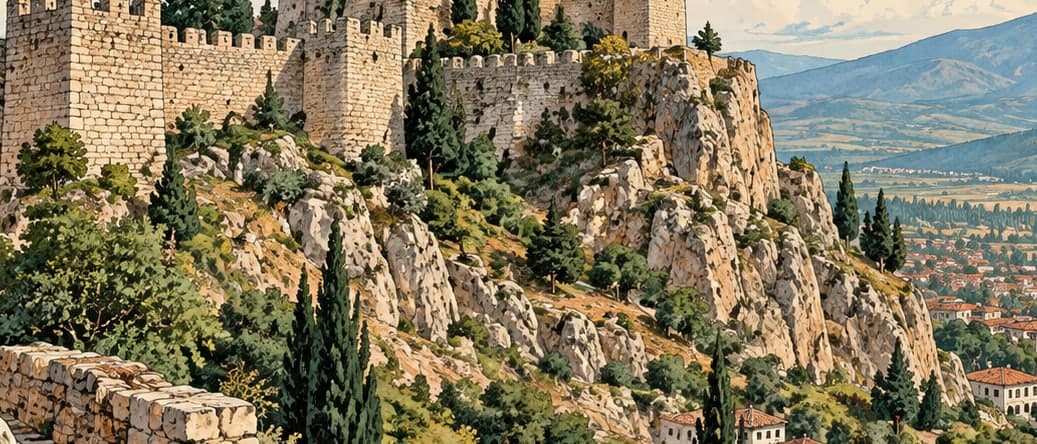
Aizanoi was the main settlement of the Aizanitis, who lived under Phrygian rule. Excavation around the temple of Zeus on the city's high plateau has turned up traces of settlement from the 3rd millennium BC. In the Hellenistic period the region belonged by turns to Pergamon and to Bithynia, passing to Rome in 133 BC. Under the Roman empire grain, wine and wool made the city wealthy and its reputation travelled well beyond the region, though definite evidence of urbanisation appears only towards the end of the 1st century BC, which is also when the first coins were struck here. The city peaked in the 2nd century AD with a wave of building. It was a bishop's seat in the early Byzantine period and lost that standing from the 7th century. In the Middle Ages the temple platform was turned into a fortress, and because the Çavdar Tatars used it as a base in the Seljuk period the place came to be called Çavdarhisar.
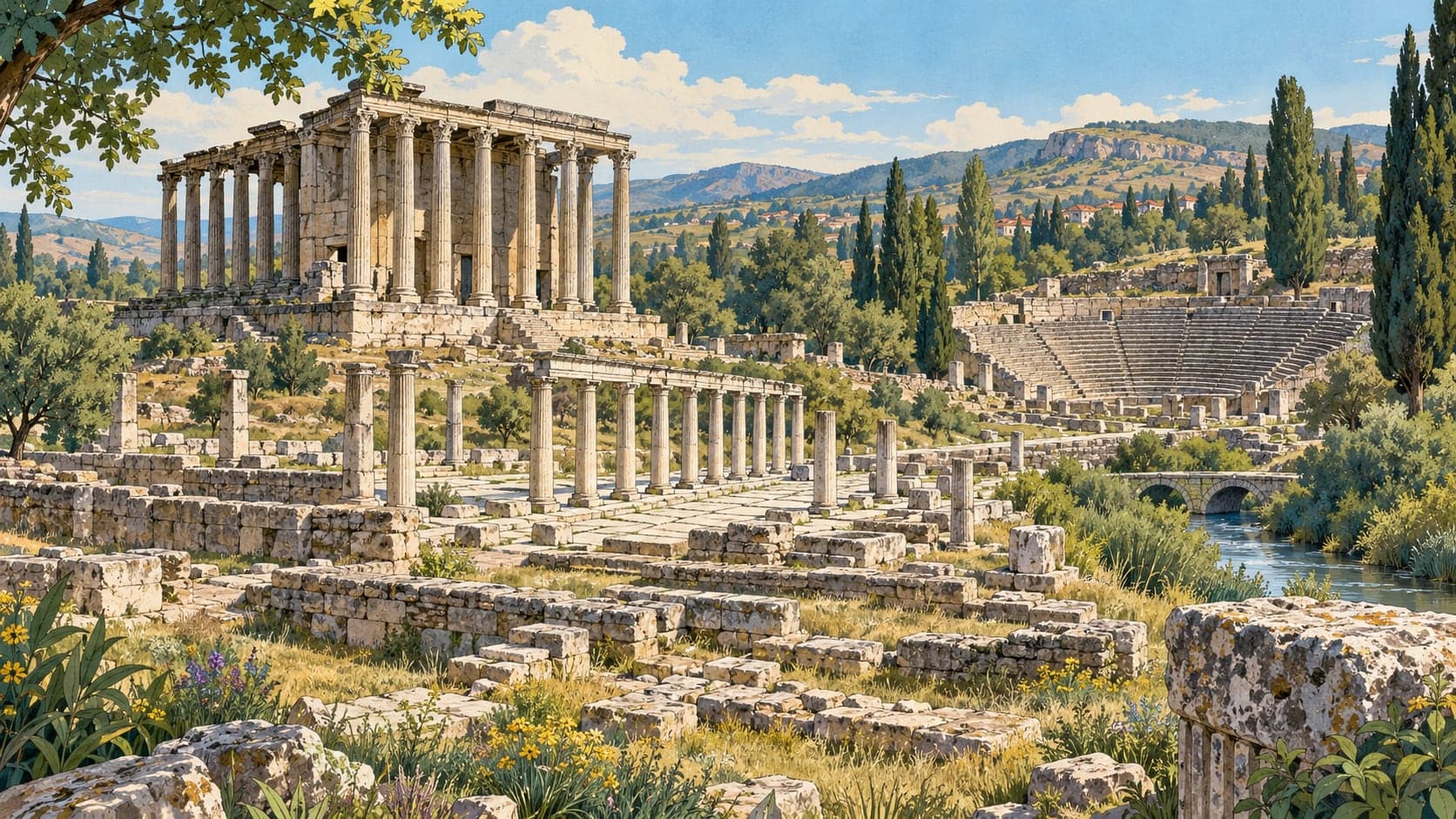
European travellers rediscovered Aizanoi in 1824; it was studied and described through the 1830s and 1840s, and the first excavations were carried out in 1926 by the German Archaeological Institute under M. Schede and D. Krencker. Work has run every year since 1970. Among the remains are the best-preserved temple of Zeus in Anatolia, a theatre, a stadium built directly against it, two baths, a colonnaded street, five bridges over the Kocaçay of which two still stand, two agoras, a gymnasium, the sanctuary of Meter Steunene, cemeteries, an ancient dam, water channels and gate structures.
Three of these the Ministry singles out as without parallel. The temple is the only example of its pseudodipteral plan and one of the best-preserved temples of Zeus in the world. The joining of stadium and theatre into a single complex is not found anywhere else in the ancient world. And the macellum, the market building of the 2nd century AD, is described as one of the world's first commodity exchanges — its walls carry the well-preserved inscriptions of the price edict Diocletian issued in AD 301 to fight inflation, listing what goods sold for in the markets of the empire. Aizanoi has been on the UNESCO World Heritage Tentative List since 2012.
The temple itself stands about two hundred metres from the west bank of the river, on a 35 by 35 metre podium at the centre of a 130.5 by 112 metre precinct ringed by colonnaded galleries. Built of marble from quarries near the city, it was begun in AD 92 and completed under Hadrian (AD 117–138). Eight columns stand on its short sides and fifteen on the long, and a stair descends to an underground chamber dedicated to the Phrygian goddess Meter Steunene while another climbs to the roof. Of its decoration the acroteria are the most striking: on the western pediment the central acroterion carries a bust of Cybele among acanthus stems and leaves, and on the eastern a bust of Zeus. The walls of its front gallery carry inscriptions praising Hadrian and Apuleius, who performed important services for the city. Çavdarhisar is 50 kilometres from Kütahya and is served by the district buses and by those running to Emet and Gediz.