Guide
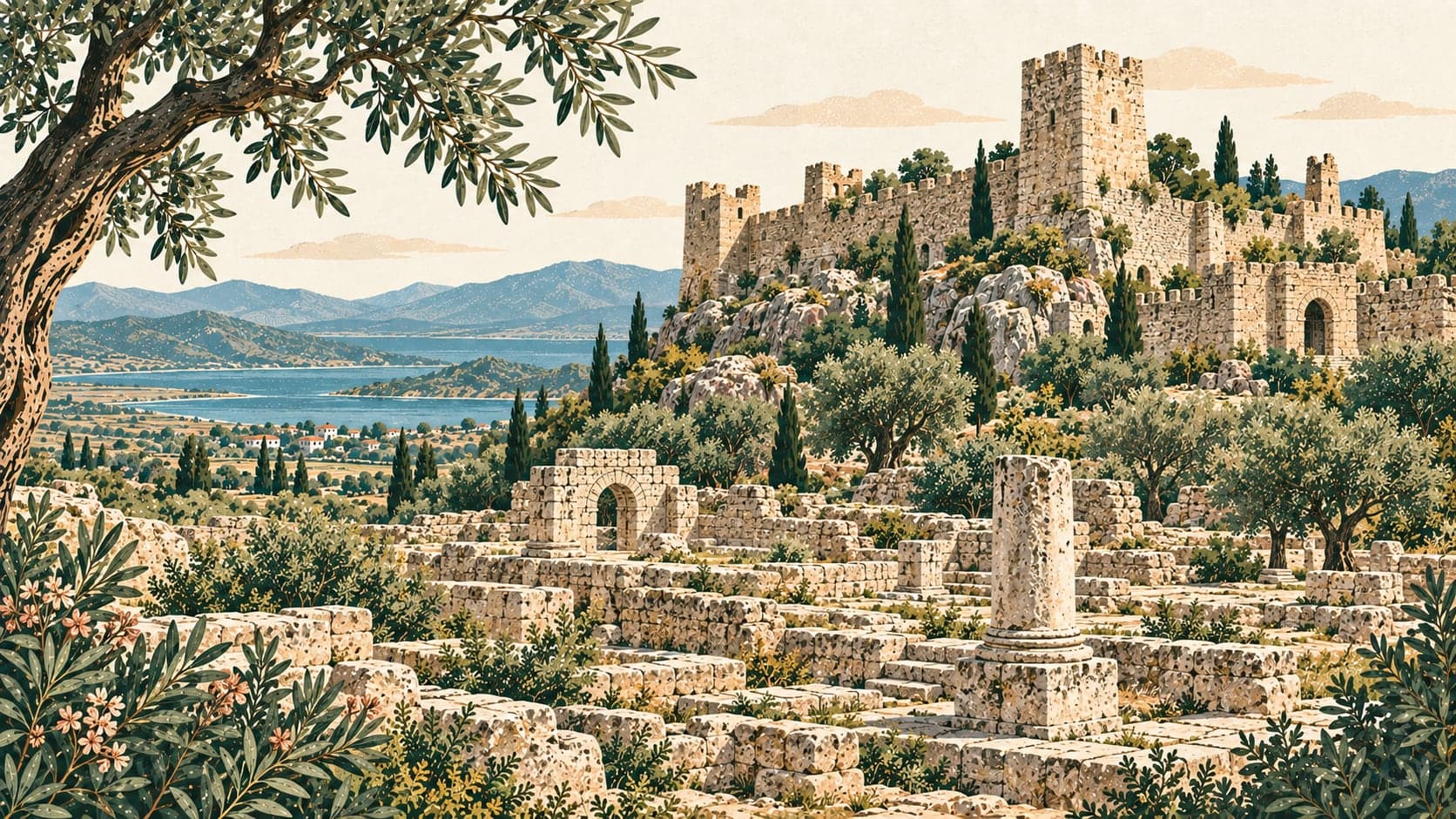
Beçin Castle stands on a hill above the plain near Milas in Muğla. The name appears as Pezona in a medieval Italian document, as Berçin in Ibn Battuta, and as Peçin in Menteşe and Ottoman sources. People settled on the hill as early as the Bronze Age, but the castle itself was built in the Byzantine period.
Beçin remained a small settlement until the first half of the fourteenth century, when the Menteşe emirate took it and made it their capital. The settlement inside the walls was built up in particular by Ahmed Bey, one of the Menteşe lords, and its growth stopped when the capital moved from here to Balat.
The sources name different places as the seat of the Menteşe lords. Menteşe Bey, who founded the emirate, sat at Fethiye, and Mesud Bey, who followed him, at Milas, where Mevlana's grandson Ulu Arif Çelebi visited him. Orhan Bey, who came after Mesud, mounted an unsuccessful campaign against Rhodes after his father's death around 1320 and then settled for a short time at Muğla, a town safer for lying further inland than the coast. From Muğla he moved to Beçin and made it his capital. Paul Wittek puts Orhan Bey's choice of Beçin, commanding the plain, over Milas down in the plain itself to the castle's strategic position and to how secure it was.
The Arab traveller Ibn Battuta, who visited Muğla and then Milas in 1332, met Orhan Bey at his residence in Beçin, and records that the mosque in the castle was then still being built.
After Orhan Bey's death the emirate was ruled by his son İbrahim Bey, and when he died his sons divided the lands between them and the unity of the emirate was broken. Beçin fell to Musa Bey in this period, and on his death to his brother Ahmed Gazi.
Beçin came under Ottoman rule around 1390. Having been an important centre for the Menteşe emirate until then, it lost its standing when the Ottomans moved the capital of their new sancak to Milas and, after 1425, to Muğla. Not a single building of the Ottoman period is found at Beçin. Evliya Çelebi, who visited in the seventeenth century, wrote that the settlement inside the walls had once been a large town but that the town he saw and the castle walls were in ruin; he counted twenty households inside the walls and recorded that the castle served as a prison with a warden and twenty soldiers. By the eighteenth century Beçin had been abandoned altogether.
Excavation and restoration are under way at the castle today, and it has been placed on the UNESCO tentative world heritage list.