Guide
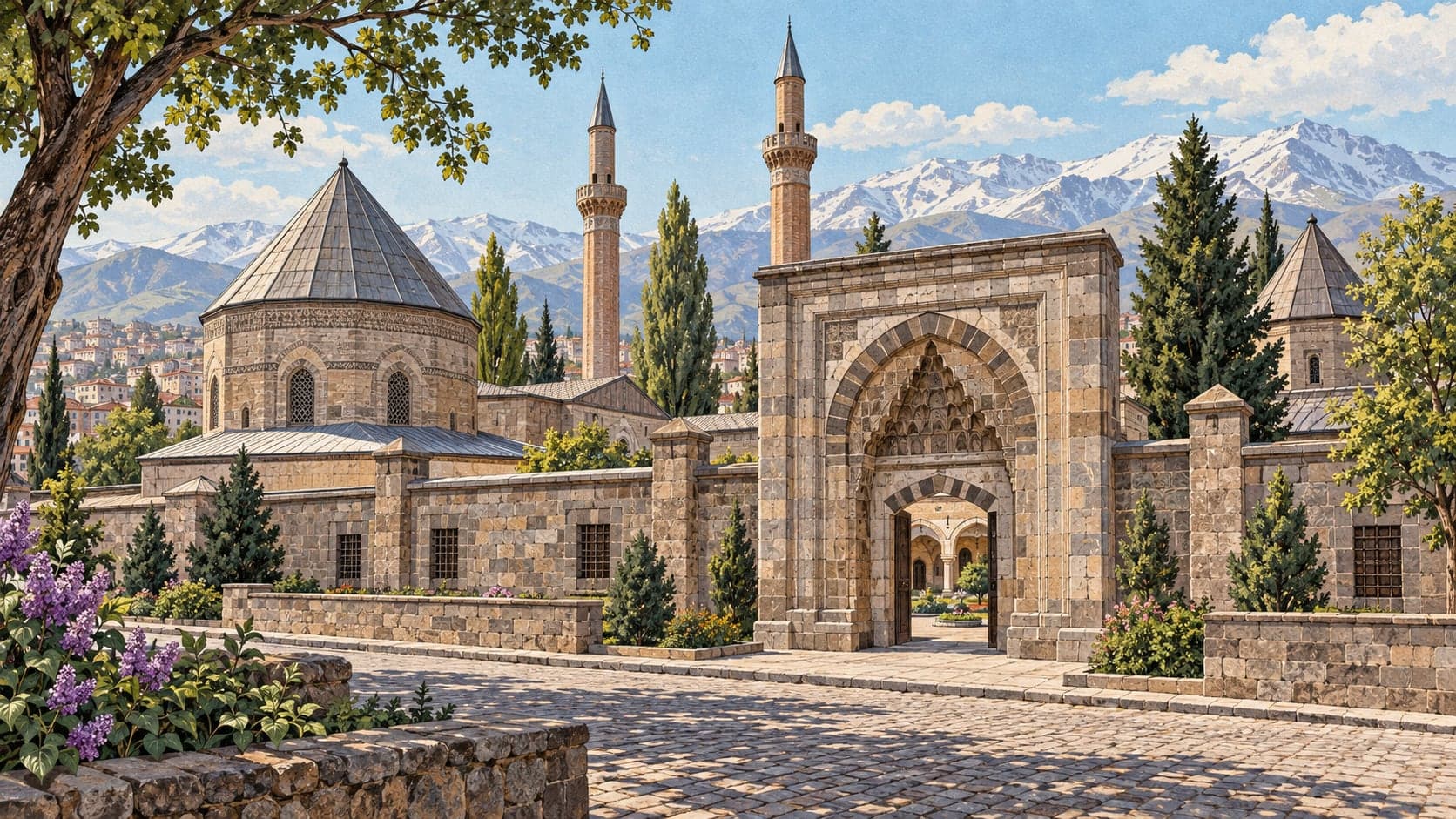
Erzurum's best-known building, the Seljuk medrese with the twin minarets, holds a museum of foundation works. According to the directorate general of foundations, which owns and maintains it, the medrese was built at the end of the thirteenth century by a Seljuk sultan; it measures roughly 35 by 46 metres, stands on two floors around an open courtyard with four eyvans, and is counted among the most important examples of that plan. It was pressed into other service at times in its history, used as a cannon foundry and as a barracks.
The building was restored between 2011 and 2016, and in 2019 a conservation board decision brought it into museum status. It had been closed for a long stretch, and reopened in 2021 as the Vakıf Eserleri Müzesi.
About ninety objects are displayed in some ten rooms on the medrese's first floor, all of them restored and conserved for exhibition: manuscripts and copies of the Qur'an, calligraphic panels, candlesticks, carpets and kilims, clocks, a mosque banner, a soup-kitchen cauldron, censers and rosewater sprinklers. Images are projected onto the walls with music so that visitors can look at the old motifs while they listen, and scale models of the Kaaba and of the mosques at Medina and Jerusalem, made by the Erzurum modelmaker Doğan Hattatoğlu, are shown in protected cases.