Guide
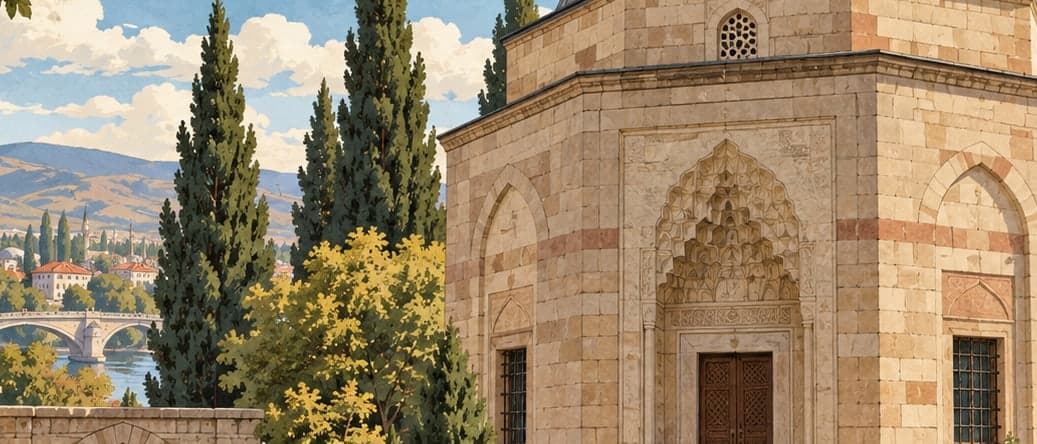
The story the complex tells about itself begins with a dream. Seyyid Battal Gazi's grave is said to have been found through one, after which Ümmühan Hatun, the mother of Alaeddin Keykubat I, raised a tomb over it and then a mosque beside it. Everything else grew around that point.
The Ottomans added a medrese, a soup kitchen, a lodge and a dervish house. Repairs and additions followed under Mehmed II, Bayezid II and Selim I. Süleyman the Magnificent called in on his Iranian campaigns and had work done; when his army camped here on the way to Iraq he had Matrakçı Nasuh paint a miniature of the town. Murad IV added a caravanserai during the Revan campaign.
Seyitgazi lay on the road from İstanbul to Baghdad and the Hijaz, so pilgrims stopped here, and that traffic deepened its religious weight. The medrese made it a centre of Islamic learning; the lodge made it a centre first of the Kalenderi dervishes and later of the Bektashi order. Hacı Bektaş-ı Veli is said to have visited and asked Orhan Gazi to develop the place, and Orhan Gazi is said to have settled a thousand households here.
The parts of the complex are named for what happened in them. The zikir room, where young dervishes gathered through the night, is said to have been built in 1511. The Kırklar room takes its name from the gatherings held in the house of Fatima and belongs to Bektashi religious teaching. The Halife Meydanı, with the caliph's sheepskin and throne, is where the cem ceremonies were held.
The bread house has two ovens set on the east side of a domed room, with a hearth beside them and another in the north wall; on the wall facing the courtyard a red inscription names Muhammad, Seyyid Battal Gazi, Ali and Allah. The slope of the hill meant that cellars were dug under the northern parts of the complex, which is unusual among the complexes of the fifteenth and sixteenth centuries. The soup kitchen, domed, with eight hearths whose chimneys rise above the dome, fed both the community and the poor of the district; Evliya Çelebi saw water being boiled in two of the large hearths and food cooked in the rest.